

The KNUH news
홈 > The KNUH > The KNUH news
[KNUH No.269_Information] Unstaffed Stores Become a New Consumer Space
작성자 : 영자신문
작성일 : 2026-06-19 00:12:29
조회 : 797
Unstaffed Stores Become a New Consumer Space
In recent years, various types of unstaffed stores have become a common sight on city streets. What once centered mainly on self-service ice cream shops has now expanded into everyday necessities such as bread, eggs, and other household goods.
Unstaffed stores operate without on-site employees, relying instead on shelves and kiosks for sales and payment. Because labor costs are reduced, products are often sold at relatively lower prices.
However, concerns have also emerged regarding the heavy dependence on public security for store protection and the practice of displaying photos of customers captured on CCTV cameras inside stores.
Against this backdrop, this article examines the new everyday landscape created by the spread of unstaffed stores, while exploring both their advantages and limitations.
The Normalization of Contactless Consumption
Unstaffed stores operate on a system in which customers select products and complete payments on their own. Unlike traditional stores, purchases are made without direct interaction with employees. In the early stages, most unstaffed stores were small-scale shops selling items such as ice cream and snacks, which were relatively easy to manage. Recently, however, they have expanded into a wider range of product categories and become more deeply integrated into daily life.
Several factors have contributed to this trend. Technological advancements, including the widespread adoption of kiosks and self-checkout systems, have enabled contactless consumption without face-to-face interaction with staff. In addition, consumer culture shifted toward minimizing in-person contact after the COVID-19 pandemic, accelerating the growth of unstaffed stores. Rising labor costs and labor shortages have also increased the burden on small business owners, further encouraging the expansion of unstaffed retail spaces.
Mr. A, who operates an unstaffed store near the back gate of Kangwon National University, explained his motivation for starting the business: “As labor costs continue to rise, the biggest advantage is that I can start and run a business with relatively low operating expenses.”

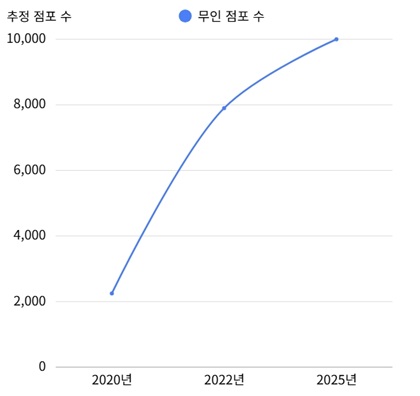
▲ Estimated growth in the number of unstaffed stores nationwide, based on Samsung Card data from April last year. The number of unstaffed stores is estimated to have increased nearly fourfold over the past five years.
Unstaffed stores represent a new style of consumption centered on efficiency and convenience. Consumers can quickly purchase what they need without waiting in line or interacting with employees, which aligns closely with the fast-paced lifestyles of modern society. In particular, their popularity has grown in university districts, where students often seek quick and efficient shopping experiences. Most unstaffed stores operate 24 hours a day and offer simple payment systems, making them especially convenient for students with busy schedules.
Han, a student in the College of Humanities at Kangwon National University, said, “I mainly use unstaffed convenience stores and stationery shops. They’re useful when I suddenly need something.” Han added, “The prices are relatively affordable, and the payment process is simple, so I visit them often when I’m short on time.”
Shin, a student majoring in Political Science and International Relations, also commented, “Being able to use the store without interacting with people reduces psychological pressure. For simple purchases, I tend to prefer unstaffed stores.”
Unstaffed Stores Expanding in Diverse Forms
Recently, unstaffed stores have expanded into unique spaces covering various aspects of everyday life, including bread shops, egg stores, stationery stores, and pet supply shops. As these stores increasingly focus on products closely tied to consumers’ daily routines, they are evolving beyond places for simple purchases into destinations people actively seek out for essential goods. In addition, services themselves are becoming automated, with the emergence of unmanned gyms, cafés, and photo studios.

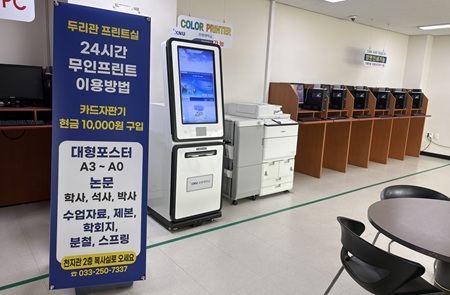
▲ A 24-hour self-service printing room located in Durigwan at Kangwon National University. Unstaffed stores are rapidly expanding while handling a growing variety of products and services.
This shift also reflects the diversification of consumer behavior. Early unstaffed stores relied mainly on price competitiveness, but recent stores are developing in ways that emphasize both convenience and product differentiation. For example, unmanned bakeries sell freshly baked bread and handmade desserts produced on the same day, while unmanned egg stores often supply fresh products directly from farms.
Because these stores connect producers and consumers more directly, they can reduce distribution processes and secure price competitiveness. Simplified logistics reduce additional costs such as transportation and storage expenses. As a result, products can be sold at lower prices, creating a positive cycle that benefits both consumers and producers.
Stores targeting specific customer groups, such as unmanned stationery shops and pet supply stores, are also increasing. This suggests that unstaffed stores are no longer merely temporary solutions for reducing labor costs, but are developing into a distinct retail model that reflects diverse consumer needs.
Especially in university districts and residential areas, unstaffed stores do not necessarily replace traditional shops. Instead, they complement existing consumption patterns by filling gaps in situations where conventional shopping methods are inconvenient or unavailable. As product categories and operating methods diversify, unstaffed stores are becoming more widely utilized in everyday life.
Between Convenience and Limitations: Perspectives of Users
Although unstaffed stores undoubtedly provide convenient shopping experiences, they cannot fully replace traditional stores in every situation.
Han, another student at Kangwon National University, said, “When it’s difficult to find an item or when I need assistance, stores with employees still feel more comfortable.” This suggests that while unstaffed stores are designed around efficiency, there are still areas where human interaction remains important.
The structure of unstaffed stores is fundamentally based on customer autonomy and responsibility. However, maintaining this structure is not always easy. Theft and unauthorized use remain among the most commonly cited problems facing unmanned stores. To address these issues, most stores rely on CCTV surveillance and warning notices.

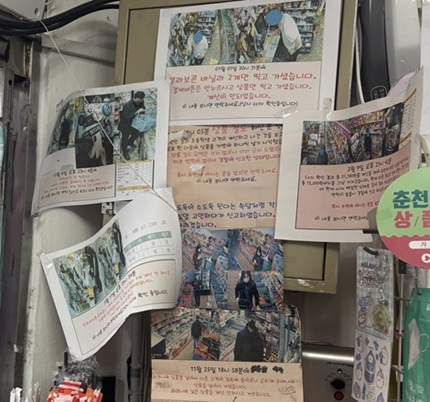
▲ A photo of a customer accused of taking products without payment displayed inside an unstaffed store. Some consumers argue that such methods may create discomfort and feelings of surveillance.
Some stores have gone a step further by printing and displaying CCTV images of suspected shoplifters, leading to additional controversy.
Shin commented, “I understand that it’s intended to prevent theft, but displaying people’s photos could make customers feel as though they are constantly being monitored.”
Mr. A explained, “There are cases in which people take products without paying, which creates a real burden for store owners. Because of this, measures such as warning signs and enhanced CCTV monitoring are sometimes unavoidable.”
Unstaffed Stores Built on Trust
Unstaffed stores have rapidly spread by emphasizing efficiency and convenience, creating a new form of consumer culture. These spaces are meaningful because they operate on mutual trust. Consumers are expected to pay voluntarily and use the facilities responsibly, while store owners maintain operations with minimal supervision, naturally forming a relationship based on trust.
Mr. B, who operates an unstaffed store near the main gate of Kangwon National University, said, “As a store owner, installing CCTV and posting customer photos are minimal measures to reduce damage, but I also fully understand that these actions may make some consumers uncomfortable. If possible, excessive methods should be avoided, and it is important to establish a culture of mutual trust.”
The spread of unstaffed stores represents not only a change in retail systems but also an evolution in consumer culture. As efficiency and convenience become increasingly valued, technology is playing a larger role in supporting consumption, making everyday shopping experiences more flexible and accessible. Environments that allow people to shop regardless of time or location are gradually becoming established as a new form of consumer culture suited to modern lifestyles.
However, for unstaffed stores to remain sustainable, technological convenience alone is not enough. Greater civic awareness and responsible consumer behavior must also support these systems. Only when these conditions are met can unstaffed stores firmly establish themselves as a lasting part of everyday life.
Byun Minsol
<solsolmins@daum.net>